May weather forecastAnchorage, AK
May
Weather in May
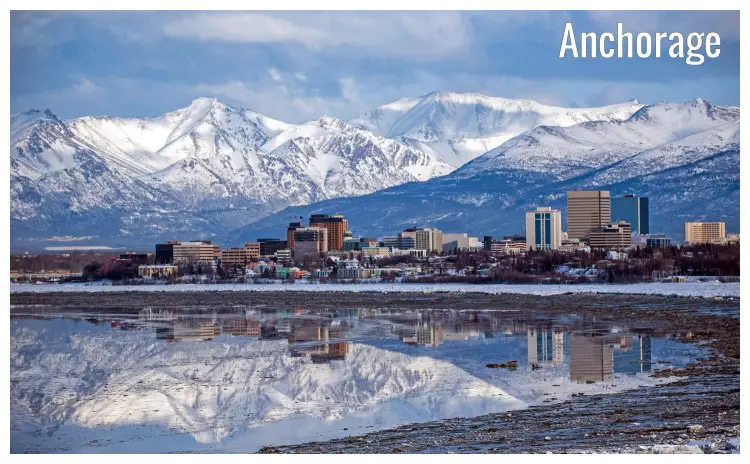
May in Anchorage is characterized by mild weather and blooming flora, bringing a rejuvenating vibe to the city. The icy grip of winter has released completely now, hence temperatures continue their ascent, providing a favorable climate. Another striking change is the significant increase in the hours of sunlight, creating longer days and shorter nights. With the virtually negligible snowfall and encouraging weather, it is a perfect time to explore the city. Sunlit snow-capped peaks against the backdrop of crystal-clear blue skies render an unforgettable image of Anchorage during May.Temperature
A rise in the average high-temperature is observed during May, moving from a cold 39.6°F (4.2°C) in April to a cool 51.1°F (10.6°C). Throughout May, Anchorage witnesses a consistent average low-temperature of 40.5°F (4.7°C).Humidity
The least humid month is May, with an average relative humidity of 68%.Rainfall
May is the month with the least rainfall. Rain falls for 11.5 days and accumulates 0.55" (14mm) of precipitation.Snowfall
Months with snowfall are January through May, September through December. May is the last month it regularly snows. During 0.3 snowfall days, in May, Anchorage aggregates 0.12" (3mm) of snow. Throughout the year, there are 59.3 snowfall days, and 23.5" (597mm) of snow is accumulated.Ocean temperature
In Anchorage, in May, the average water temperature is 42.4°F (5.8°C).Note: Caution: 42.4°F (5.8°C) temperatures below 50°F (10°C) during swimming can result in intense cold shock and quickened breathing.
Daylight
The average length of the day in May is 17h and 33min.On the first day of May, sunrise is at 5:47 am and sunset at 10:05 pm. On the last day of the month, sunrise is at 4:35 am and sunset at 11:19 pm AKDT.
Sunshine
May and June, with an average of 11.7h of sunshine, are months with the most sunshine.UV index
The average daily maximum UV index in May is 3. A UV Index value of 3 to 5 symbolizes a medium vulnerability from unsafe exposure to UV radiation for ordinary individuals.Note: The maximum UV index, 3 during May, leads to the following recommendations:
Adopt protective measures - It is advised to guard against sun damage. When the Sun is at its strongest around midday, find shade and limit exposure. A wide-brim hat offers excellent sun protection for the eyes, ears, face, and neck. Sunglasses with UVA and UVB protection significantly reduce eye damage from sun exposure. Be aware! The reflective nature of snow can magnify the Sun's UV radiation almost twofold.
Published by: Weather U.S. | About Us
Data Sources | Weather Forecasting & Climate
Frequently asked questions
Average temperature in May
Anchorage, AK
- Average high temperature in May: 51.1°F
The warmest month (with the highest average high temperature) is July (61.9°F).
The month with the lowest average high temperature is January (20.3°F).
- Average low temperature in May: 40.5°F
The month with the highest average low temperature is July (51.3°F).
The coldest month (with the lowest average low temperature) is January (13.1°F).
Average pressure in May
Anchorage, AK
- Average pressure in May: 29.93"Hg
The month with the highest atmospheric pressure is July (29.96"Hg).
The months with the lowest atmospheric pressure are November and December (29.67"Hg).
Average wind speed in May
Anchorage, AK
- Average wind speed in May: 5.2mph
The windiest month (with the highest average wind speed) is November (6.3mph).
The calmest month (with the lowest average wind speed) is July (4.5mph).
Average humidity in May
Anchorage, AK
- Average humidity in May: 68%
The months with the highest relative humidity are January, February and March (86%).
The month with the lowest relative humidity is May (68%).
Average rainfall in May
Anchorage, AK
- Average rainfall in May: 0.55"
The wettest month (with the highest rainfall) is September (1.93").
The driest month (with the least rainfall) is May (0.55").
Average rainfall days in May
Anchorage, AK
- Average rainfall days in May: 11.5 days
The month with the highest number of rainy days is August (17.9 days).
The month with the least rainy days is February (7 days).
Average snowfall in May
Anchorage, AK
- Average snowfall in May: 0.12"
The month with the highest snowfall is December (5.51").
The months with the least snowfall are June, July and August (0").
Average snowfall days in May
Anchorage, AK
- Average snowfall days in May: 0.3 days
The month with the highest number of snowfall days is December (11.6 days).
The months with the least snowfall days are June, July and August (0 days).
Average sea temperature in May
Anchorage, AK
- Average sea temperature in May: 42.4°F
The best month for swimming (with the highest average sea temperature) is August (53.1°F).
The coldest month (with the lowest average sea temperature) is February (35.8°F).
Average daylight in May /
Average sunshine in May
Anchorage, AK
- Average daylight in May: 17h and 36min
The month with the longest days is June (Average daylight: 19h and 12min).
The month with the shortest days is December (Average daylight: 5h and 36min).
- Average sunshine in May: 11h and 42min
The months with the most sunshine are May and June (Average sunshine: 11h and 42min).
The month with the least sunshine is December (Average sunshine: 3h and 48min).
Average sunshine days in May
Anchorage, AK
- Average sunshine days in May: 16.3 days
The month with the most sunshine days is January (16.9 days).
The month with the least sunshine days is September (11.1 days).
Average UV index in May
Anchorage, AK
- Average UV index in May: 3
The months with the highest UV index are June and July (UV index 4).
The month with the lowest UV index is February (UV index 1).
Average cloud cover in May
Anchorage, AK
- Average cloud cover in May: 38
The month with the most cloud cover is December (Cloud cover 47).
The month with the least cloud cover is May (Cloud cover 38).
Average visibility in May
Anchorage, AK
- Average visibility in May: 6mi
The months with the highest visibility are January, February, April, May, June, July, August, September, October, November and December (6mi).
The month with the lowest visibility is March (5mi).


