May weather forecastSeward, AK
May
Weather in May
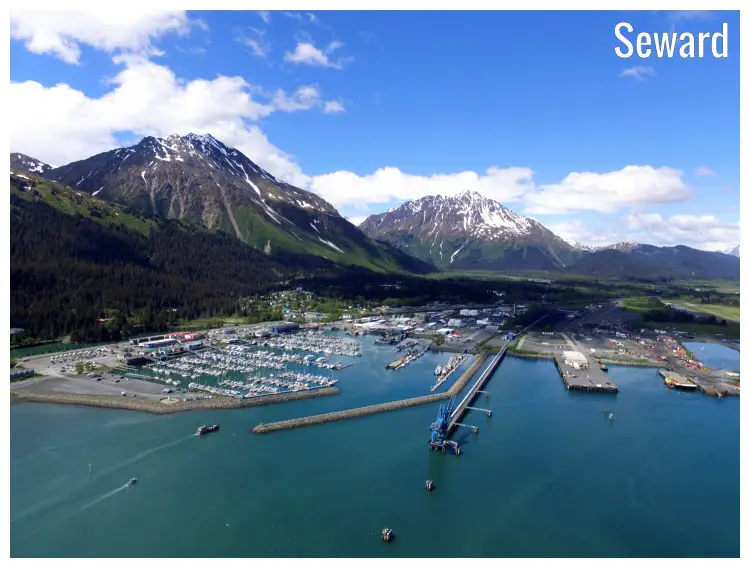
May is predominantly the onset of the summer season for Seward. The most notable characteristic is the considerable increase in temperature, up to a high of 44.2°F (6.8°C) compared to the preceding months. The skies clear out substantially, affording more daylight hours for both residents and tourists alike. With the pleasant temperature swing, outdoor activities become a favourite pastime. Given the pleasant weather, May is an ideal month for visiting Seward and exploring its natural splendour.Temperature
As Seward welcomes May, the average high-temperature sees a modest rise, transitioning from a wintry 35.4°F (1.9°C) in April to a chilly 44.2°F (6.8°C). During May, nights cool slightly to an average low of 35.4°F (1.9°C).Humidity
The average relative humidity in May is 82%.Rainfall
In Seward, in May, during 16 rainfall days, 3.82" (97mm) of precipitation is typically accumulated. Throughout the year, in Seward, there are 166.9 rainfall days, and 56.06" (1424mm) of precipitation is accumulated.Snowfall
Months with snowfall are January through May, October through December. May is the last month it regularly snows. During 0.8 snowfall days, in May, Seward aggregates 0.47" (12mm) of snow. Throughout the year, there are 72 snowfall days, and 73.19" (1859mm) of snow is accumulated.Ocean temperature
In Seward, the average seawater temperature in May is 45.1°F (7.3°C).Note: At temperatures below 50°F (10°C), swimming in a suitably protected swimsuit is feasible; otherwise, cold shock and loss of breathing control are imminent. Even a short swim, without thermal protection, at temperatures around 55.4°F (13°C) is not comfortable.
Daylight
In Seward, the average length of the day in May is 17h and 16min.On the first day of May, sunrise is at 5:51 am and sunset at 9:57 pm. On the last day of the month, sunrise is at 4:45 am and sunset at 11:05 pm AKDT.
Sunshine
The average sunshine in May is 8.6h.UV index
The average daily maximum UV index in May is 2. A UV Index of 2, and less, symbolizes a low threat to health from exposure to the Sun's UV rays for average individuals.Note: In May, an average UV index of 2 transforms into the following instructions:
While many people can endure lengthy sun exposure, it remains imperative to safeguard babies, children, and fair-skinned individuals. Sun's radiation is most powerful around mid-day, so it's best to limit outdoor activities during this time. Employ a wide-brim hat for potent defense against up to 50% of UV rays. Note this! The Sun's UV radiation can nearly be doubled by the reflection off snow.
Published by: Weather U.S. | About Us
Data Sources | Weather Forecasting & Climate
Frequently asked questions
Average temperature in May
Seward, AK
- Average high temperature in May: 44.2°F
The warmest month (with the highest average high temperature) is July (56.8°F).
The month with the lowest average high temperature is January (24.6°F).
- Average low temperature in May: 35.4°F
The month with the highest average low temperature is July (47.8°F).
The coldest month (with the lowest average low temperature) is January (17.1°F).
Average pressure in May
Seward, AK
- Average pressure in May: 29.93"Hg
The month with the highest atmospheric pressure is July (29.98"Hg).
The month with the lowest atmospheric pressure is November (29.61"Hg).
Average wind speed in May
Seward, AK
- Average wind speed in May: 5.4mph
The windiest month (with the highest average wind speed) is November (8.9mph).
The calmest month (with the lowest average wind speed) is June (4.8mph).
Average humidity in May
Seward, AK
- Average humidity in May: 82%
The months with the highest relative humidity are March, April and December (87%).
The month with the lowest relative humidity is June (80%).
Average rainfall in May
Seward, AK
- Average rainfall in May: 3.82"
The wettest month (with the highest rainfall) is December (7.64").
The driest month (with the least rainfall) is June (2.09").
Average rainfall days in May
Seward, AK
- Average rainfall days in May: 16 days
The month with the highest number of rainy days is August (19 days).
The month with the least rainy days is February (7.6 days).
Average snowfall in May
Seward, AK
- Average snowfall in May: 0.47"
The month with the highest snowfall is February (18.35").
The months with the least snowfall are June, July, August and September (0").
Average snowfall days in May
Seward, AK
- Average snowfall days in May: 0.8 days
The month with the highest number of snowfall days is March (14.3 days).
The months with the least snowfall days are June, July, August and September (0 days).
Average sea temperature in May
Seward, AK
- Average sea temperature in May: 45.2°F
The best month for swimming (with the highest average sea temperature) is August (56°F).
The coldest month (with the lowest average sea temperature) is March (39°F).
Average daylight in May /
Average sunshine in May
Seward, AK
- Average daylight in May: 17h and 18min
The month with the longest days is June (Average daylight: 18h and 48min).
The month with the shortest days is December (Average daylight: 6h and 0min).
- Average sunshine in May: 8h and 36min
The month with the most sunshine is June (Average sunshine: 9h and 30min).
The months with the least sunshine are January and December (Average sunshine: 3h and 6min).
Average sunshine days in May
Seward, AK
- Average sunshine days in May: 11.9 days
The month with the most sunshine days is January (13.8 days).
The month with the least sunshine days is September (10.6 days).
Average UV index in May
Seward, AK
- Average UV index in May: 2
The month with the highest UV index is July (UV index 4).
The months with the lowest UV index are January, October, November and December (UV index 1).
Average cloud cover in May
Seward, AK
- Average cloud cover in May: 53
The month with the most cloud cover is December (Cloud cover 55).
The months with the least cloud cover are March and November (Cloud cover 50).
Average visibility in May
Seward, AK
- Average visibility in May: 5mi
The months with the highest visibility are June, July, August, September, October and November (6mi).
The months with the lowest visibility are January, February, March, April, May and December (5mi).


