Climate and monthly weather forecastSarasota, FL
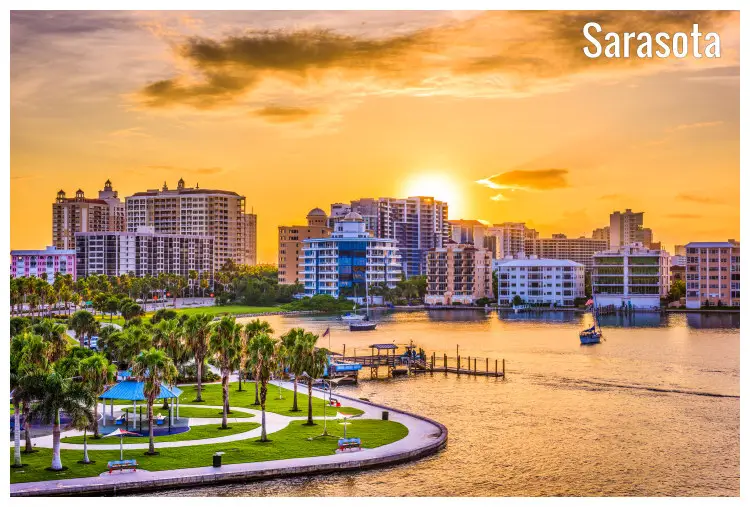
Climate and monthly weather forecast
The climate of Sarasota
Sarasota, Florida, balances on the precipice of the humid subtropical Köppen climate classification (Cfa), with the defining characteristic of having no dry season. It's geographical location is nestled on the southwest coastline of the Florida peninsula, granting it the pleasure of the Gulf of Mexico's marine influence. This seaside city's climate undergoes an eclectic mix of weather expressions throughout its journey around the sun.Temperature patterns in Sarasota undergo a slow, disciplined climb from a modest January average high of 68.5°F (20.3°C), peaking at a balmy 88.5°F (31.4°C) in August. This mercurial rise in temperature is mirrored by a concurrent period of escalating night-time lows, with the mercury dipping from 56.1°F (13.4°C) in January to 79.7°F (26.5°C) in August. But the atmosphere doesn't stop at directing thermal displays; it plays an essential role in sculpting the levels of humidity, which maintain a consistent presence of between 72 to 76% throughout the year.
Rainfall levels unveil another pattern in Sarasota's weather; a distinctive shift from drier to wetter periods. The first quarter of the year ushers in moderate rainfall of between 1.06" (27mm) to 1.34" (34mm). However, these numbers quickly multiply, inflating to a copious 6.42" (163mm) by August, definitely the wettest month of the year. Together, these weather parameters yield a compelling narrative of this city's climate, with episodes of boundless sunshine, spans of high humidity, and bursts of substantial rainfall.
The best time to visit Sarasota
The period from November to April embodies the most inviting time to visit Sarasota. This span of months ushers in cooler temperatures, with highs oscillating between 68.5°F (20.3°C) and 82.6°F (28.1°C). Even more enticing is the dramatic contraction in the amount of rainfall during these months. Visitors can expect no more than 1.97" (50mm) of precipitation in December, representing the driest phase Sarasota experiences in the year. Moreover, this window offsets the risks of torrential downpours with abundant sunshine, making the city a formidable destination for sun-seekers.The worst time to visit Sarasota
Visitors might want to forgo plans to visit Sarasota from June through September. The mercury undergoes a sharp upwards curtail during these months, with the average highs rocketing to between 87.3°F (30.7°C) and 88.5°F (31.4°C). Moreover, this period coincides with the zenith of rainfall, peaking at the dizzying height of 6.42" (163mm) in August. Consequently, this phase of the year is typically marred by persistent and often extensive rain showers.Spring weather in Sarasota
Spring ushers in a mild phase in Sarasota, where temperatures lie in a pleasant range between 71.2°F (21.8°C) and 80.2°F (26.8°C). The soothing climatic period also brings with it a gradual increase in the levels of rainfall, transitioning from 1.06" (27mm) in February to 1.34" (34mm) by April. Throughout this period, visitors can enjoy an average daylight span of 12 hours and modest humidity levels that never exceed 75%.Summer weather in Sarasota
Summers in Sarasota see an escalation in temperature, hovering between 84.2°F (29°C) and 88.5°F (31.4°C). Coinciding with this increase, the city witnesses a surge in rainfall, with June picking up to 5.55" (141mm) and reaching the annual high of 6.42" (163mm) by August. Despite the propensity for rain, sunshine remains a steadfast companion with up to 13.5 hours of daylight in June.Autumn weather in Sarasota
Autumn in Sarasota signals a retreat in temperatures and, more distinctly, a tapering off in rainfall. While September basks in the residual warmth of summer at 86.9°F (30.5°C), by November, the highs capitulate to a more temperate 76.3°F (24.6°C). Similarly, the rainfall patterns show a noteworthy descent from 4.61" (117mm) in September to a much lower 1.06" (27mm) by November.Winter weather in Sarasota
Winter months in Sarasota offer a respite from the year's scorching highs and drenching rains. Temperatures during this period are gentle, with daytime highs varying from 68.5°F (20.3°C) in December to 72.5°F (22.5°C) by February. Concurrently, these months receive the least rainfall in the year, providing an annual low of 1.97" (50mm) in December. This drier period is complemented by extended sunshine hours, providing visitors ample opportunity to explore and enjoy the charms of Sarasota, completely unencumbered by unfavorable weather.Weather in January
January ushers in Sarasota's calendar year with mild winter weather. Relative humidity hovers around 73%, with cloud cover at 30%. Temperatures fluctuate between a soothing 56.1°F (13.4°C) at night, climbing gradually to a comfortable 68.5°F (20.3°C) during the day. Weather in January »Weather in February
Sarasota's February weather ushers in a slightly warmer ambience compared to January. The sea temperature starts to hint at the approaching mild spring, while gentle breezes continue to nurture the calm atmosphere in the city. Weather in February »Weather in March
The city of Sarasota welcomes March with fine, mild weather typical of the late winter transitioning into early spring. Daylight increases to 12 hours per day, and the UV index moves up the scale, indicating more sunny days. One notable feature of March is the rise in rainfall to 1.26" (32mm), which signifies a slight increment compared to February. Weather in March »Weather in April
Sarasota's April begs to differ from the previous month by introducing a pronounced change in the weather. Sarasota witnesses longer daylight hours extending to 12.8 hours, creating more opportunities for outdoor pursuits. A visible increase in temperature is evident, signifying the arrival of warmer spring mornings and nights. Weather in April »Weather in May
May in Sarasota is characterized by the arrival of a warmer climatic period, signaling the beginning of a hot summer. The sea temperature noticeably increases, leading to warmer and more humid coastline days. Sunshine duration extends to 13.5 hours a day, with a noticeable rise in the UV index, marking the onset of summer. Weather in May »Weather in June
June brings sultry summer days to Sarasota, with temperatures that are noticeably higher than in May. An increased number of sunny hours of 13.9 per day paints the town a shade brighter, adding to the vibrancy of summer in Sarasota. Weather in June »Weather in July
The Sarasota summer continues to sear through July, with temperatures remaining comfortably high. This marks the peak of the summer months with the maximum temperatures reaching up to 88°F (31.1°C) during the day. The cloud cover is slightly heavier than in June, and wind speed continues to lose momentum, making for calm, sultry days. Weather in July »Weather in August
The August weather in Sarasota carries forward the essence of summer from July without any drastic changes. Daylight hours reduce marginally to 13.1 hours a day, subtly indicating the impending transition to autumn. Despite high temperatures, the town appears gorgeous in its thick cloud cover and balmy weather. Weather in August »Weather in September
Sarasota's September weather rings in slight changes as summer slowly starts to recede, paving the way for milder autumn. Daylight hours progressively shorten to 12.3 hours a day, indicating the near arrival of shorter autumn days. Weather in September »Weather in October
October in Sarasota is marked by a distinct shift towards the mild weather conditions of the fall season. The sea temperature drops noticeably, and the daytime temperature also takes a slight dip, leaning towards the cooler end of the scale. Weather in October »Weather in November
November ushers Sarasota into the winter season, prompting observable drops in temperature. The shift in weather from warm to cold is gradually noticeable, with a reduction in daylight hours to 10.8. Even sea temperatures recede, paving the way for cooler breezy evenings by the coast. Weather in November »Weather in December
December in Sarasota wraps up the year with a full entrance into winter, bringing correspondingly lower temperatures. The weather becomes cooler and more comfortable, helping locals and visitors embrace the festive season. The UV index drops to 5 and daylight shortens to 10.4 hours a day, indicating shorter days and long, chilly nights. Weather in December »Published by: Weather U.S. | About Us
Data Sources | Weather Forecasting & Climate
Frequently asked questions
Average temperature
Sarasota, FL
The warmest month (with the highest average high temperature) is August (88.5°F).
The month with the lowest average high temperature is January (68.5°F).
The month with the highest average low temperature is August (79.7°F).
The coldest month (with the lowest average low temperature) is January (56.1°F).
Average pressure
Sarasota, FL
- Average pressure in January:
30.13"Hg - Average pressure in February:
30.1"Hg - Average pressure in March:
30.09"Hg - Average pressure in April:
30.02"Hg - Average pressure in May:
30"Hg - Average pressure in June:
29.99"Hg
- Average pressure in July:
30.02"Hg - Average pressure in August:
29.98"Hg - Average pressure in September:
29.95"Hg - Average pressure in October:
29.97"Hg - Average pressure in November:
30.06"Hg - Average pressure in December:
30.1"Hg
The month with the highest atmospheric pressure is January (30.13"Hg).
The month with the lowest atmospheric pressure is September (29.95"Hg).
Average wind speed
Sarasota, FL
- Average wind speed in January:
9.3mph - Average wind speed in February:
8.8mph - Average wind speed in March:
9.1mph - Average wind speed in April:
8.7mph - Average wind speed in May:
8mph - Average wind speed in June:
6.8mph
- Average wind speed in July:
6.4mph - Average wind speed in August:
6.7mph - Average wind speed in September:
7.2mph - Average wind speed in October:
9mph - Average wind speed in November:
9.2mph - Average wind speed in December:
8.9mph
The windiest month (with the highest average wind speed) is January (9.3mph).
The calmest month (with the lowest average wind speed) is July (6.4mph).
Average humidity
Sarasota, FL
The month with the highest relative humidity is December (76%).
The months with the lowest relative humidity are March, April and May (72%).
Average rainfall
Sarasota, FL
- Average rainfall in January:
1.22" - Average rainfall in February:
1.06" - Average rainfall in March:
1.26" - Average rainfall in April:
1.34" - Average rainfall in May:
2.56" - Average rainfall in June:
5.55"
- Average rainfall in July:
5.94" - Average rainfall in August:
6.42" - Average rainfall in September:
4.61" - Average rainfall in October:
1.93" - Average rainfall in November:
1.06" - Average rainfall in December:
1.97"
The wettest month (with the highest rainfall) is August (6.42").
The driest months (with the least rainfall) are February and November (1.06").
Average rainfall days
Sarasota, FL
- Average rainfall days in January:
8.3 days - Average rainfall days in February:
8.3 days - Average rainfall days in March:
9.2 days - Average rainfall days in April:
11.6 days - Average rainfall days in May:
15.1 days - Average rainfall days in June:
22.2 days
- Average rainfall days in July:
26.2 days - Average rainfall days in August:
26.8 days - Average rainfall days in September:
23.5 days - Average rainfall days in October:
14.3 days - Average rainfall days in November:
8.3 days - Average rainfall days in December:
9.3 days
The month with the highest number of rainy days is August (26.8 days).
The months with the least rainy days are January, February and November (8.3 days).
Average sea temperature
Sarasota, FL
The best month for swimming (with the highest average sea temperature) is August (86.7°F).
The coldest month (with the lowest average sea temperature) is January (64.1°F).
Average daylight / Average sunshine
Sarasota, FL
- Average daylight in January:
10h and 36min - Average daylight in February:
11h and 12min - Average daylight in March:
12h and 0min - Average daylight in April:
12h and 48min - Average daylight in May:
13h and 30min - Average daylight in June:
13h and 48min
- Average daylight in July:
13h and 42min - Average daylight in August:
13h and 6min - Average daylight in September:
12h and 18min - Average daylight in October:
11h and 30min - Average daylight in November:
10h and 48min - Average daylight in December:
10h and 30min
The month with the longest days is June (Average daylight: 13h and 48min).
The month with the shortest days is December (Average daylight: 10h and 30min).
- Average sunshine in January:
7h and 18min - Average sunshine in February:
8h and 30min - Average sunshine in March:
8h and 42min - Average sunshine in April:
9h and 30min - Average sunshine in May:
11h and 6min - Average sunshine in June:
10h and 48min
- Average sunshine in July:
10h and 54min - Average sunshine in August:
9h and 36min - Average sunshine in September:
9h and 0min - Average sunshine in October:
7h and 48min - Average sunshine in November:
6h and 42min - Average sunshine in December:
6h and 30min
The month with the most sunshine is May (Average sunshine: 11h and 6min).
The month with the least sunshine is December (Average sunshine: 6h and 30min).
Average sunshine days
Sarasota, FL
- Average sunshine days in January:
21.1 days - Average sunshine days in February:
18.2 days - Average sunshine days in March:
20.1 days - Average sunshine days in April:
16.1 days - Average sunshine days in May:
14 days - Average sunshine days in June:
5.8 days
- Average sunshine days in July:
2.7 days - Average sunshine days in August:
2.5 days - Average sunshine days in September:
4.5 days - Average sunshine days in October:
14.9 days - Average sunshine days in November:
20 days - Average sunshine days in December:
18.9 days
The month with the most sunshine days is January (21.1 days).
The month with the least sunshine days is August (2.5 days).
Average UV index
Sarasota, FL
The months with the highest UV index are May, June, July, August and September (UV index 7).
The month with the lowest UV index is January (UV index 4).
Average cloud cover
Sarasota, FL
The months with the most cloud cover are January and December (Cloud cover 30).
The month with the least cloud cover is May (Cloud cover 22).
Average visibility
Sarasota, FL
The months with the highest visibility are January, February, March, April, May, June, July, August, September, October, November and December (6mi).
The months with the lowest visibility are January, February, March, April, May, June, July, August, September, October, November and December (6mi).


