August weather forecastChicago, IL
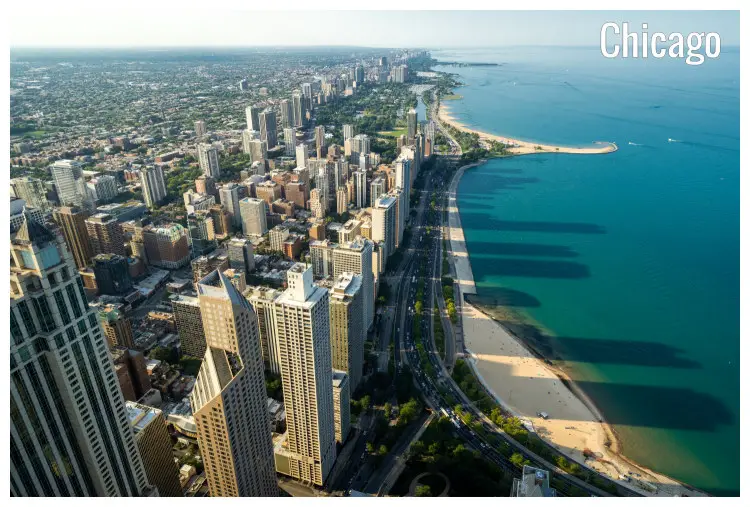
August
Weather in August
August maintains the summer momentum in Chicago, providing locals and visitors with ample sunshine and heat. The weather conditions are similar to July, maintaining high temperatures and favorable conditions for outdoor activities or sightseeing. However, toward the end of the month, there is a subtle drop in temperatures indicating an impending change. Prepare to bid farewell to the peak summer season and embrace the approach of autumn as the city transitions in the late August days.Temperature
In Chicago, August is identified by the highest average temperatures, reaching a peak of 77.5°F (25.3°C) and a low of 67.6°F (19.8°C).Humidity
In Chicago, the average relative humidity in August is 76%.Rainfall
In August, the rain falls for 17.3 days. Throughout August, 4.06" (103mm) of precipitation is accumulated. Throughout the year, there are 160.2 rainfall days, and 36.97" (939mm) of precipitation is accumulated.Snowfall
In Chicago, snow does not fall in June through October.Ocean temperature
The month with the warmest seawater is August, with an average ocean temperature of 73.9°F (23.3°C).Note: Factor in your tolerance to cold, the sunshine, the wind, and the air's warmth, and a swim in 73.9°F (23.3°C) might be tempting. It is interesting to note that Olympians compete in 77°F (25°C) to 82.4°F (28°C) water temperatures.
Daylight
In Chicago, the average length of the day in August is 13h and 49min.On the first day of August, sunrise is at 5:45 am and sunset at 8:08 pm. On the last day of the month, sunrise is at 6:16 am and sunset at 7:25 pm CDT.
Sunshine
July and August, with an average of 10.6h of sunshine, are months with the most sunshine.UV index
July and August, with an average maximum UV index of 6, are months with the highest UV index. A UV Index reading of 6 to 7 represents a high health hazard from exposure to the Sun's UV rays for average individuals.Note: In August, the maximum UV index of 6 suggests this advice:
Act on precautions and pay attention to sun safety recommendations. Avoidance of sunburn is obligatory. It's important to stay in the shade and limit exposure to the sun from 10 a.m. to 4 p.m., when UV radiation is most intense, although remember that shade structures may not provide full sun protection. A wide-brimmed hat is a staple for defending the face, eyes, ears, and neck from the Sun. Take warning! Reflective sand and water surfaces intensify the Sun's UV rays.
Published by: Weather U.S. | About Us
Data Sources | Weather Forecasting & Climate
Frequently asked questions
Average temperature in August
Chicago, IL
- Average high temperature in August: 77.5°F
The warmest month (with the highest average high temperature) is August (77.5°F).
The month with the lowest average high temperature is January (29.7°F).
- Average low temperature in August: 67.6°F
The month with the highest average low temperature is July (67.8°F).
The coldest month (with the lowest average low temperature) is January (20.7°F).
Average pressure in August
Chicago, IL
- Average pressure in August: 29.98"Hg
The month with the highest atmospheric pressure is January (30.11"Hg).
The month with the lowest atmospheric pressure is June (29.92"Hg).
Average wind speed in August
Chicago, IL
- Average wind speed in August: 7.8mph
The windiest month (with the highest average wind speed) is January (12.5mph).
The calmest month (with the lowest average wind speed) is July (7.7mph).
Average humidity in August
Chicago, IL
- Average humidity in August: 76%
The month with the highest relative humidity is January (82%).
The month with the lowest relative humidity is October (73%).
Average rainfall in August
Chicago, IL
- Average rainfall in August: 4.06"
The wettest month (with the highest rainfall) is June (4.88").
The driest month (with the least rainfall) is December (1.65").
Average rainfall days in August
Chicago, IL
- Average rainfall days in August: 17.3 days
The month with the highest number of rainy days is July (18.5 days).
The month with the least rainy days is February (5.5 days).
Average snowfall in August
Chicago, IL
- Average snowfall in August: 0"
The month with the highest snowfall is February (3.54").
The months with the least snowfall are June, July, August, September and October (0").
Average snowfall days in August
Chicago, IL
- Average snowfall days in August: 0 days
The month with the highest number of snowfall days is January (10.6 days).
The months with the least snowfall days are June, July, August and September (0 days).
Average sea temperature in August
Chicago, IL
- Average sea temperature in August: 73.9°F
The best month for swimming (with the highest average sea temperature) is August (73.9°F).
The coldest month (with the lowest average sea temperature) is February (36.9°F).
Average daylight in August /
Average sunshine in August
Chicago, IL
- Average daylight in August: 13h and 48min
The month with the longest days is June (Average daylight: 15h and 12min).
The month with the shortest days is December (Average daylight: 9h and 12min).
- Average sunshine in August: 10h and 36min
The months with the most sunshine are July and August (Average sunshine: 10h and 36min).
The month with the least sunshine is January (Average sunshine: 3h and 42min).
Average sunshine days in August
Chicago, IL
- Average sunshine days in August: 9.8 days
The month with the most sunshine days is December (15.5 days).
The month with the least sunshine days is July (9.3 days).
Average UV index in August
Chicago, IL
- Average UV index in August: 6
The months with the highest UV index are July and August (UV index 6).
The months with the lowest UV index are January and December (UV index 1).
Average cloud cover in August
Chicago, IL
- Average cloud cover in August: 27
The month with the most cloud cover is January (Cloud cover 62).
The months with the least cloud cover are July and August (Cloud cover 27).
Average visibility in August
Chicago, IL
- Average visibility in August: 6mi
The months with the highest visibility are January, February, March, April, May, June, July, August, September, October, November and December (6mi).
The months with the lowest visibility are January, February, March, April, May, June, July, August, September, October, November and December (6mi).


