November weather forecastAnn Arbor, MI
November
Weather in November
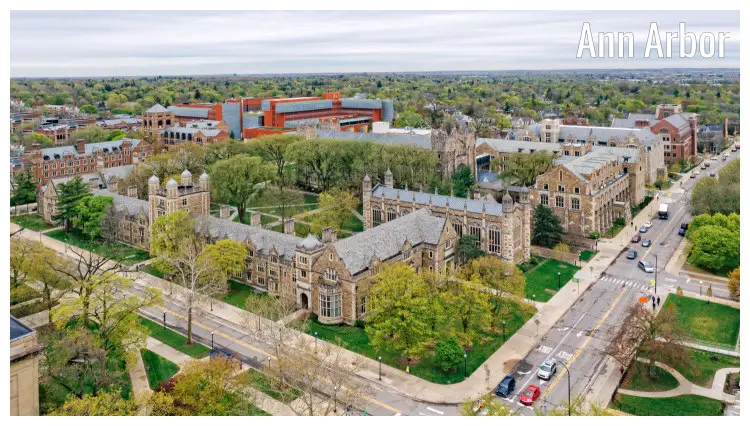
November in Ann Arbor ushers in the start of the cold season, with a significant drop in temperature. The trees shed their leaves preparing for winter, while the city gears up for the holiday season. The first snowfall often occurs during this time, officially marking winter's arrival. Despite the chill, the weather remains crisp, leading to clear, frosty mornings. November's low temperature plummets to an average of 33.4°F (0.8°C), an 11°F (-11.7°C) drop from October, evidence of the swift transition into winter.Temperature
Ann Arbor's November weather comes with a decrease in average high-temperatures, moving from a moderate 59.2°F (15.1°C) in October to a frosty 45.5°F (7.5°C). The nights of November anticipate an average low-temperature of 33.4°F (0.8°C).Humidity
In November, the average relative humidity is 78%.Rainfall
In Ann Arbor, in November, during 9.2 rainfall days, 1.1" (28mm) of precipitation is typically accumulated. In Ann Arbor, during the entire year, the rain falls for 144.9 days and collects up to 18.82" (478mm) of precipitation.Snowfall
January through May, October through December are months with snowfall. In Ann Arbor, in November, during 4.3 snowfall days, 1.38" (35mm) of snow is typically accumulated. In Ann Arbor, during the entire year, snow falls for 45 days and aggregates up to 9.69" (246mm) of snow.Daylight
In November, the average length of the day is 9h and 48min.On the first day of the month, sunrise is at 8:09 am and sunset at 6:28 pm EDT. On the last day of November, sunrise is at 7:43 am and sunset at 5:03 pm EST.
Note: On Sunday, November 3. 2024, at 2:00 am, Daylight Saving Time ends, and the time zone changes from EDT to EST. Daylight Saving Time starts again on Sunday, March 9. 2025, at 2:00 am; consequently, the time zone reverts from EST to EDT.
Sunshine
The average sunshine in November is 4.8h.UV index
In Ann Arbor, the average daily maximum UV index in November is 2. A UV Index estimate of 2, and below, represents a low health risk from unsafe exposure to UV radiation for the ordinary person.Note: A maximum UV index of 2 in November translates into the following recommendations:
Long-term sun exposure is typically not a concern for most. However, those with sensitive skin, infants, and children must always have protection. Considering the Sun's intensity during midday, it's wise to minimize direct exposure. Select sunglasses that boast both UVA and UVB protection to limit the adverse effects of the sun on the eyes. Remember to consider! The UV radiation from the Sun can be intensified nearly twice by the reflection of snow.
Published by: Weather U.S. | About Us
Data Sources | Weather Forecasting & Climate
Frequently asked questions
Average temperature in November
Ann Arbor, MI
- Average high temperature in November: 45.5°F
The warmest month (with the highest average high temperature) is July (79.9°F).
The month with the lowest average high temperature is January (28.2°F).
- Average low temperature in November: 33.4°F
The month with the highest average low temperature is July (62.2°F).
The coldest month (with the lowest average low temperature) is January (17.8°F).
Average pressure in November
Ann Arbor, MI
- Average pressure in November: 30.09"Hg
The months with the highest atmospheric pressure are March and November (30.09"Hg).
The month with the lowest atmospheric pressure is June (29.93"Hg).
Average wind speed in November
Ann Arbor, MI
- Average wind speed in November: 9.4mph
The windiest month (with the highest average wind speed) is January (10.1mph).
The calmest month (with the lowest average wind speed) is July (6.4mph).
Average humidity in November
Ann Arbor, MI
- Average humidity in November: 78%
The months with the highest relative humidity are January and February (86%).
The month with the lowest relative humidity is April (76%).
Average rainfall in November
Ann Arbor, MI
- Average rainfall in November: 1.1"
The wettest month (with the highest rainfall) is May (2.4").
The driest month (with the least rainfall) is December (0.87").
Average rainfall days in November
Ann Arbor, MI
- Average rainfall days in November: 9.2 days
The month with the highest number of rainy days is May (18.2 days).
The month with the least rainy days is January (5.2 days).
Average snowfall in November
Ann Arbor, MI
- Average snowfall in November: 1.38"
The month with the highest snowfall is February (2.72").
The months with the least snowfall are June, July, August and September (0").
Average snowfall days in November
Ann Arbor, MI
- Average snowfall days in November: 4.3 days
The month with the highest number of snowfall days is January (11.5 days).
The months with the least snowfall days are June, July, August and September (0 days).
Average daylight in November /
Average sunshine in November
Ann Arbor, MI
- Average daylight in November: 9h and 48min
The month with the longest days is June (Average daylight: 15h and 12min).
The month with the shortest days is December (Average daylight: 9h and 6min).
- Average sunshine in November: 4h and 48min
The month with the most sunshine is July (Average sunshine: 10h and 30min).
The month with the least sunshine is January (Average sunshine: 3h and 0min).
Average sunshine days in November
Ann Arbor, MI
- Average sunshine days in November: 16.3 days
The month with the most sunshine days is October (17.5 days).
The month with the least sunshine days is July (10.3 days).
Average UV index in November
Ann Arbor, MI
- Average UV index in November: 2
The months with the highest UV index are June, July and August (UV index 6).
The month with the lowest UV index is December (UV index 1).
Average cloud cover in November
Ann Arbor, MI
- Average cloud cover in November: 49
The month with the most cloud cover is January (Cloud cover 68).
The month with the least cloud cover is July (Cloud cover 29).
Average visibility in November
Ann Arbor, MI
- Average visibility in November: 6mi
The months with the highest visibility are February, March, April, May, June, July, August, September, October, November and December (6mi).
The month with the lowest visibility is January (5mi).


